
Learn how to select elastomeric insulation thickness for pipes, ducts and HVAC equipment using fluid temperature, humidity, pipe size and condensation risk.
How to Choose Elastomeric Insulation Thickness for Pipes, Ducts and HVAC Equipment
Quick answer: No single elastomeric insulation thickness works for every pipe, duct or HVAC installation. Select thickness using fluid temperature, ambient temperature, relative humidity, dew point, pipe diameter or surface geometry, installation location, thermal conductivity and the project’s design objective. On cold systems, the finished outer surface must remain above the surrounding air’s dew point under the selected design conditions.
Introduction
Choosing elastomeric insulation thickness is an important mechanical design decision. Insulation that is too thin can allow unwanted heat transfer and leave the outer surface of a cold system below the dew point, causing condensation. Adding thickness without calculation is not automatically economical either: it increases material cost, occupied space and installation complexity.
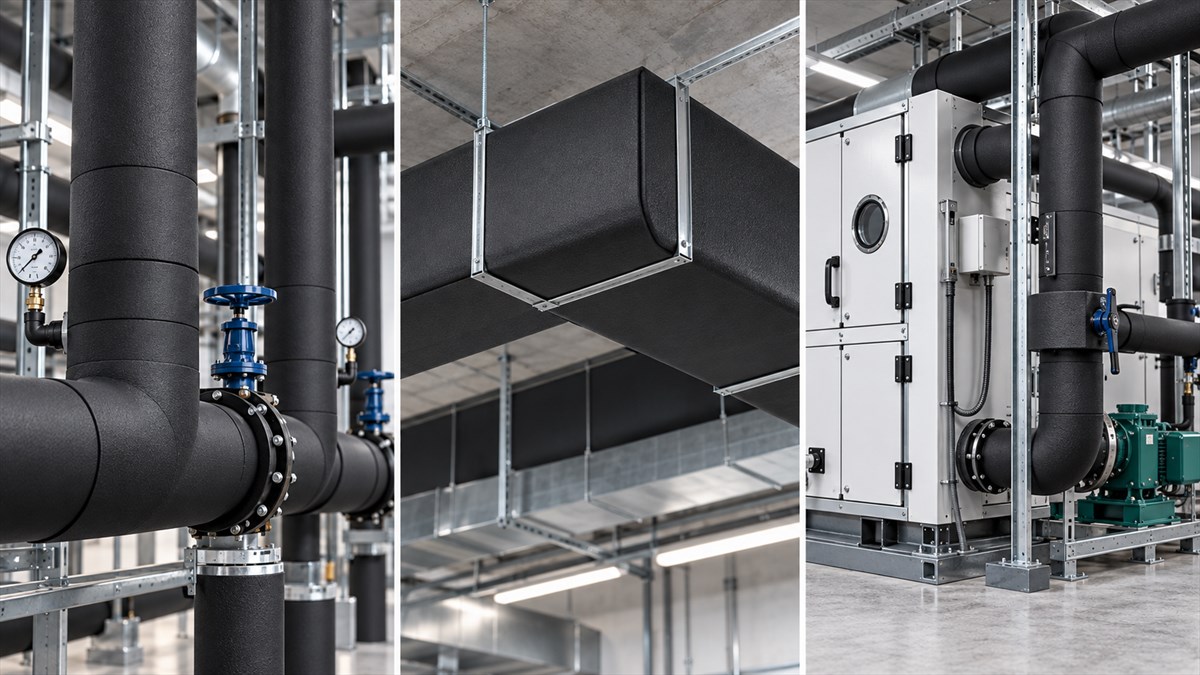
A chilled-water pipe in a conditioned room faces different conditions from one in a warm plant room, a cold-air duct above an unconditioned ceiling, or equipment outdoors in a humid climate. This guide explains the main design variables, Clint Veneta’s tubular and roll product ranges, and a practical first step for selecting insulation on pipes, ducts and HVAC equipment.
Why does insulation thickness matter?
Thickness affects the thermal resistance of the complete system. On cooling systems, the usual goals are to limit heat gain and prevent condensation on the exposed surface. On heating systems, heat-loss reduction and surface-temperature control often take priority. In both cases, the thickness must suit the real operating and ambient conditions.
- Reduce unwanted heat transfer and support energy efficiency.
- Help prevent condensation and dripping from cold pipes, ducts and equipment.
- Reduce moisture damage to adjacent materials and equipment.
- Help maintain the required fluid or air temperature along the distribution route.
- Avoid under-insulation and unnecessary material cost.
Dew point: the key concern in cold systems
Water vapor condenses when an exposed surface reaches or falls below the dew point of the surrounding air. For a cold pipe or duct, the insulation system needs enough thermal resistance to keep its finished outer surface above that temperature under the chosen design conditions. Ambient humidity can substantially change the required thickness, so selecting a fixed value only from water temperature or pipe type is unreliable.
Illustrative ASHRAE example: ASHRAE’s mechanical-insulation guidance considers a hypothetical tank containing liquid at 4°C in a 27°C mechanical room, with insulation whose thermal conductivity is 0.043 W/(m·K). The example calculates approximately 13 mm at 60% relative humidity, 33 mm at 80%, and 74 mm at 90%. These figures show the strong effect of humidity; they are not a Clint Veneta selection table or a prescription for another project.
What determines the required thickness?
1. Fluid or surface temperature
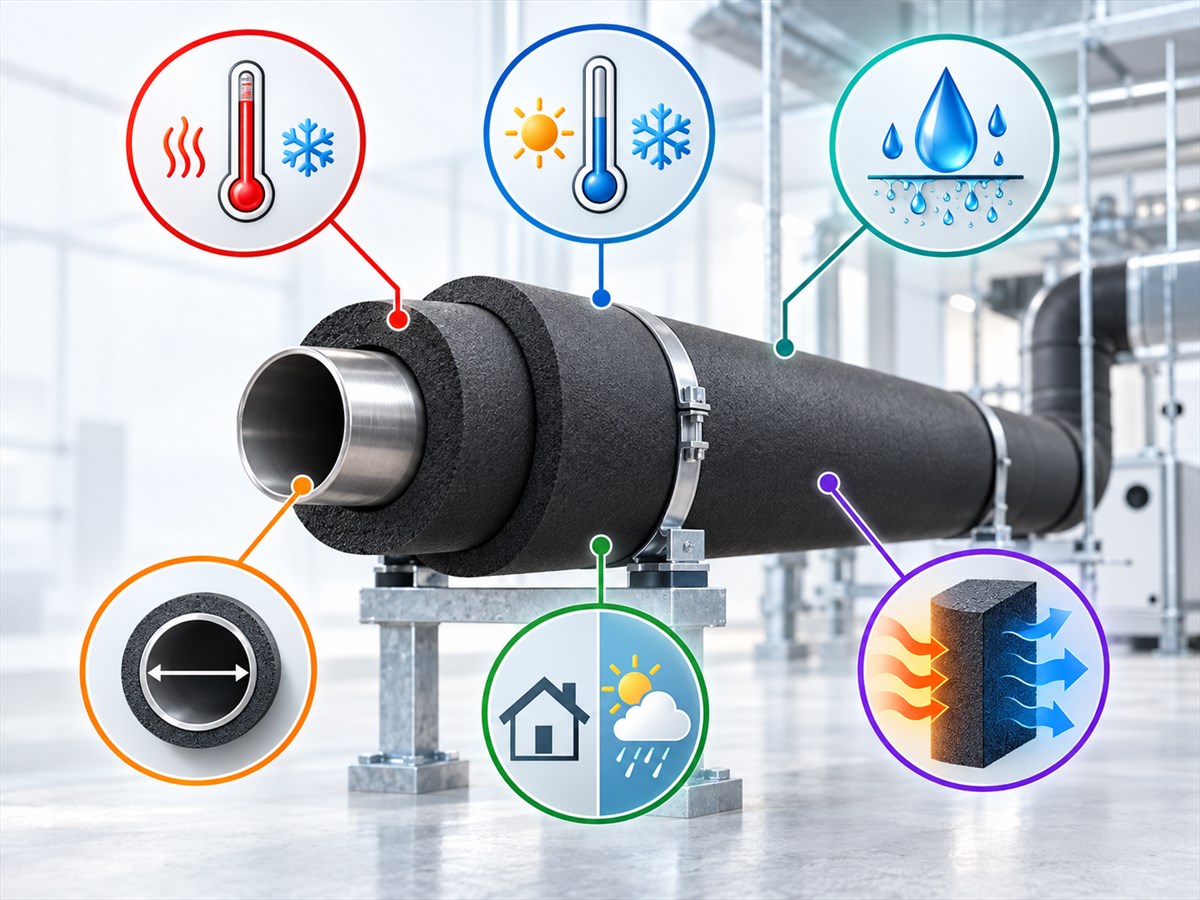
A larger temperature difference between the system and its surroundings generally increases heat transfer. Chilled-water and refrigerant lines require checks for both energy performance and condensation. On hot lines, heat loss and safe surface temperature often govern.
2. Ambient temperature and relative humidity
Temperature and humidity must be evaluated together. Warm, humid air has a higher dew point, so the insulation surface must remain warmer to avoid condensation. A conditioned room, enclosed plant room and humid outdoor location are not equivalent. Sensitive projects should use realistic worst-case conditions for the installation.
3. Pipe diameter or surface dimensions
Diameter affects heat transfer and surface temperature, while available product sizes vary. After establishing the wall thickness, match a tubular product’s internal diameter to the pipe’s outside diameter so it fits without stretching or excessive gaps.
4. Indoor or outdoor installation
Outdoor installations bring solar radiation, rain, ultraviolet exposure, temperature swings and possible mechanical damage. Protective facing or cladding may be needed, but does not replace a thickness calculation. Indoors, ceiling voids, risers, plant rooms and conditioned spaces may also have very different conditions.
5. Design objective
Condensation control may govern one project, energy efficiency or personnel protection another. The selected thickness must satisfy the most demanding applicable design requirement.
6. Thermal conductivity and workmanship
Thermal conductivity, expressed as λ, is an input to the calculation, but installed performance depends on more than the material value. Open seams, poor joints, stretched insulation, uninsulated supports and incomplete vapor sealing can undermine the system. K-FLEX installation guidance likewise stresses correct sizing and sealing at joints, terminations and fittings.
Clint Veneta’s thickness range
Clint Veneta lists elastomeric insulation in tubular and roll forms. Their ranges differ because the appropriate form depends on pipe diameter, surface geometry and installation method.
Tubular insulation
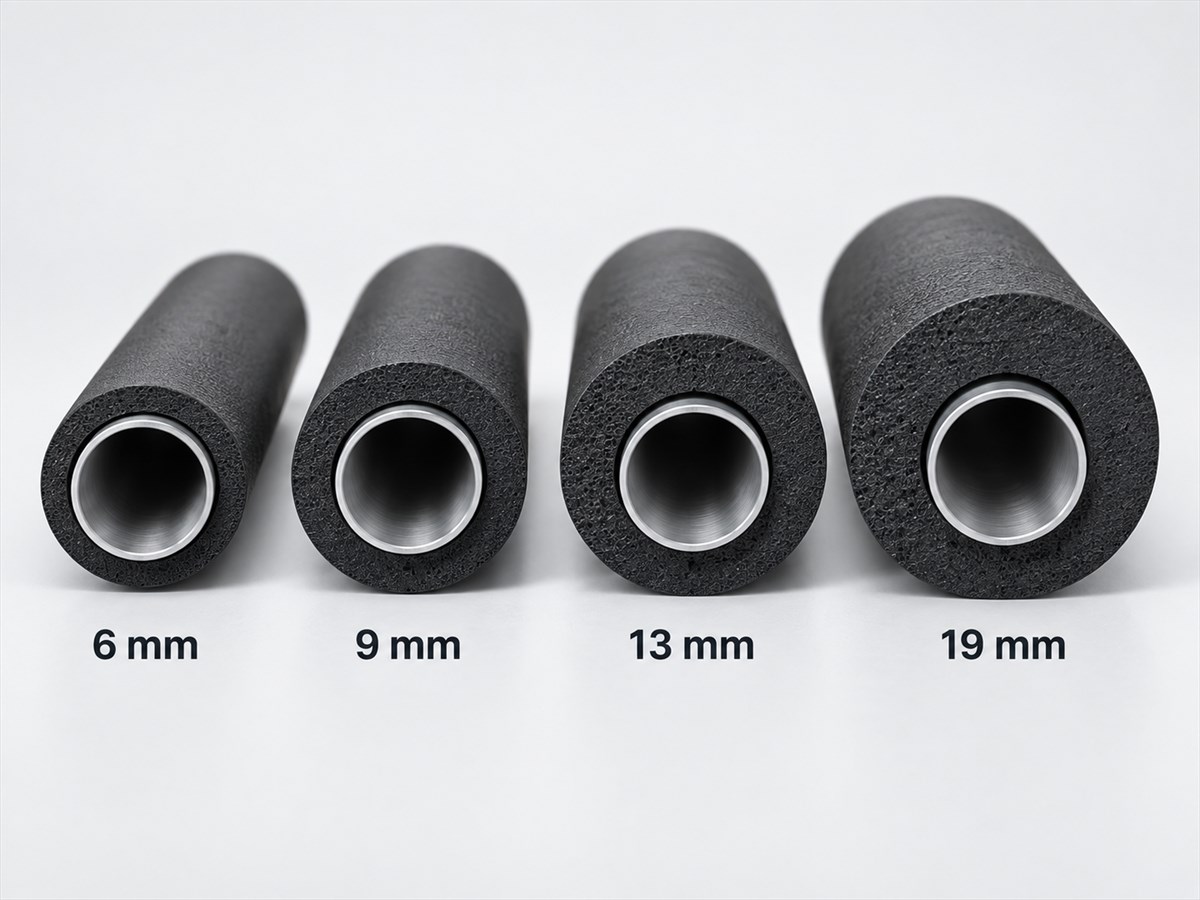
The supplied product range lists four tubular wall thicknesses: 6, 9, 13 and 19 mm. The available internal-diameter range differs by thickness.
| Wall thickness | Listed internal diameters | Selection note |
|---|---|---|
| 6 mm | 6–42 mm | Not listed for the larger pipe diameters. |
| 9 mm | 6–114 mm | Covers a broad range of pipe sizes. |
| 13 mm | 6–114 mm | Covers a broad range of pipe sizes. |
| 19 mm | 10–114 mm | The 6 and 8 mm internal diameters are not listed at this wall thickness. |
Roll insulation
Clint Veneta lists roll insulation in seven thicknesses: 6, 9, 13, 19, 25, 32 and 50 mm. Roll material can cover air ducts, tanks, equipment and larger surfaces, including pipes where a suitable preformed tube is unavailable or impractical.
| Listed roll thicknesses |
|---|
| 6 mm |
| 9 mm |
| 13 mm |
| 19 mm |
| 25 mm |
| 32 mm |
| 50 mm |
Published material properties: Clint Veneta’s catalog reports thermal conductivity λ of 0.032 W/(m·K), a service-temperature range of −70°C to +120°C, and density of 45–60 kg/m³. Use the applicable product data and test conditions for project calculations; a range table alone does not establish a safe thickness.
A preliminary thickness guide for pipes
Begin with fluid temperature, ambient temperature, relative humidity and pipe diameter. The table below is a screening aid, not a replacement for a project calculation, consultant specification or applicable code.
| Project conditions | Thicknesses to investigate first | What to check |
|---|---|---|
| Small temperature difference, conditioned indoor space and controlled humidity | 6 or 9 mm | Check energy performance and condensation risk separately. |
| Typical indoor HVAC application under moderate conditions | 9 or 13 mm | Fluid temperature, pipe size and relative humidity remain decisive. |
| Colder fluid, higher humidity or larger pipe | 13 or 19 mm | Calculate dew point and finished surface temperature. |
| Very humid surroundings, outdoor exposure or demanding refrigeration conditions | Project-specific calculation; thicker roll material may be needed | Do not rely on a generic table. Review facing, vapor sealing and installation details. |
Cold-water and chilled-water pipes
Condensation is a principal risk on cold-water lines. The colder the water and the more humid the surroundings, the greater the thermal resistance that may be needed. For chilled-water lines in plant rooms, risers and unconditioned spaces, calculate using design water temperature, ambient temperature, relative humidity and pipe diameter. A finished surface below the dew point can sweat even when the installation appears sound.
Refrigerant lines and cold equipment
Refrigerant lines often have a larger temperature difference. Elbows, valves, fittings and supports are particularly sensitive points. Continuity of the insulation and complete vapor sealing at these locations matter as much as nominal wall thickness. Low temperatures and high humidity require project-specific assessment.
Hot-water pipes
Heat loss and surface temperature are the main criteria on hot-water lines. Condensation is normally not the controlling concern, but too little insulation can increase energy use. Economic thickness also depends on operating hours, fluid and ambient temperatures, and energy cost.
Choosing thickness for HVAC ducts
A cold-air duct has a large surface area, making heat gain and condensation important. Roll insulation is commonly applied to its exterior. Determine thickness from supply-air temperature, the temperature and humidity around the duct, airflow and installation location.
- Conditioned space: Ambient conditions are usually more controlled, but the temperature difference still matters.
- Ceiling void or riser: Conditions may differ from the occupied room; higher humidity can raise condensation risk.
- Plant room or unconditioned space: Warmer, more humid surroundings may call for greater thermal resistance.
- Outdoor duct: Include protection against UV exposure, rain and mechanical damage alongside the thickness calculation.
Tanks and other HVAC equipment
Chillers, tanks, headers, valves, flanges, pumps and equipment casings are commonly insulated with sheets or rolls. Irregular geometry and numerous joints can make a continuous, vapor-tight system harder to achieve. Design and installation must maintain continuity, especially around supports and connections, so moist air cannot reach a cold surface beneath the insulation.
For large surfaces and demanding conditions, 25, 32 and 50 mm roll products provide options for greater thermal resistance. The final thickness still requires a project calculation.
Is thicker insulation always better?
No. The goal is a thickness sufficient for the design criteria, not the greatest available thickness. More insulation increases thermal resistance but also adds material cost, occupied space, support dimensions and installation complexity. Beyond a point, further heat-transfer reduction may not justify the additional cost.
Professional designs balance energy performance, condensation control, operating conditions and construction constraints. K-FLEX’s thickness guidance also identifies fluid temperature, ambient conditions, humidity, condensation risk, pipe diameter and installation environment as relevant inputs.
What does aluminum facing do?
Aluminum facing has a different role from foam thickness. It chiefly protects the insulation system from environmental and mechanical exposure, particularly outdoors. It must not be treated as a substitute for calculating the required foam thickness.
The finished surface’s radiative properties can also affect its temperature and the condensation calculation. On sensitive projects, assess the specified facing together with thickness, ambient conditions and the design objective. Armacell’s discussion of surface emissivity explains this effect.
Common thickness-selection mistakes
- Selecting thickness from fluid temperature while ignoring ambient humidity.
- Using one thickness for every climate, pipe diameter and installation location.
- Assuming aluminum facing makes up for insufficient thermal thickness.
- Ignoring the pipe’s actual outside diameter when selecting tubular insulation.
- Stretching insulation to fit or leaving seams and terminations unsealed.
- Overlooking elbows, tees, flanges, valves and supports as critical details.
- Applying a generic online table without checking product properties and project conditions.
A practical first-pass selection process
Use this sequence to organize the information needed for a preliminary choice.
| Step | Information needed | Purpose |
|---|---|---|
| 1 | Fluid or surface temperature | Establish the temperature difference from ambient. |
| 2 | Ambient temperature and relative humidity | Determine dew point and condensation risk. |
| 3 | Pipe diameter or duct/equipment dimensions | Choose the appropriate product geometry and size. |
| 4 | Indoor, unconditioned or outdoor location | Account for exposure and protective facing. |
| 5 | Energy, condensation or surface-protection objective | Identify the governing criterion. |
| 6 | Product range and technical properties | Evaluate an available, suitable thickness. |
| 7 | Joint, fitting and support details | Maintain continuity and vapor sealing. |
Information to provide for technical advice: Share fluid temperature, ambient temperature, relative humidity, pipe outside diameter or surface dimensions, installation location and any required facing. These details allow a more useful preliminary assessment by Clint Veneta’s technical team.
Frequently asked questions
What is the best elastomeric insulation thickness?
There is no universal best thickness. The appropriate choice depends on fluid and ambient temperatures, humidity, pipe size, installation location, design objective and the selected product’s thermal properties.
What thickness should I use on a cold-water pipe?
Check dew point and condensation risk first. Depending on the project, 6, 9, 13 or 19 mm may be worth evaluating, but none can be selected reliably without fluid temperature, ambient temperature, relative humidity and pipe diameter.
What is the difference between 13 and 19 mm tubular insulation?
A 19 mm wall provides greater thermal resistance and may suit more demanding conditions. It is not always necessary or economical; the project calculation establishes whether 13 mm is sufficient.
Do humid climates require thicker insulation?
Higher humidity generally increases condensation risk and may require greater thermal resistance. Dew-point calculation, vapor sealing and the complete facing system are particularly important in humid locations.
Can aluminum facing replace additional insulation thickness?
No. Facing mainly provides environmental and mechanical protection. Treat it as part of the complete system, not as a replacement for the foam thickness required by the design.
Should I use tubular or roll insulation on a large pipe?
It depends on diameter and product availability. Where a suitable tubular size is unavailable, or for large surfaces and equipment, roll insulation may be the more practical installation choice.
Conclusion
Elastomeric insulation thickness cannot be chosen from a single parameter. Fluid temperature, ambient temperature, relative humidity, pipe size, surface geometry, installation location, design objective, thermal conductivity and workmanship all affect the outcome. Clint Veneta lists 6, 9, 13 and 19 mm tubular products and a wider roll range up to 50 mm, but the final selection must follow actual project conditions.
For a chilled-water system, ventilation duct or HVAC equipment project, send the operating and environmental details to Clint Veneta for a more focused product discussion.